

Introducing sailoQ's new project: the sailoQ ITF3, an instrument interface that connects your boat's classic sensors to today's data networks.
What it is
Many boats have sensors in perfect condition: the wind vane at the masthead, the speed log and the depth transducer in the hull. What breaks down or becomes outdated is what sits behind them. The ITF3 reads those sensors directly and sends their data to the equipment on board, so you can keep using them with a modern chartplotter or with the instruments you already have.
Which sensors it reads
- Wind: the wind vane and anemometer of the Raymarine ST60 and i60.
- Speed log: speed through the water and water temperature.
- Depth: depth, with 200 kHz transducers such as Airmar.
Where it sends the data
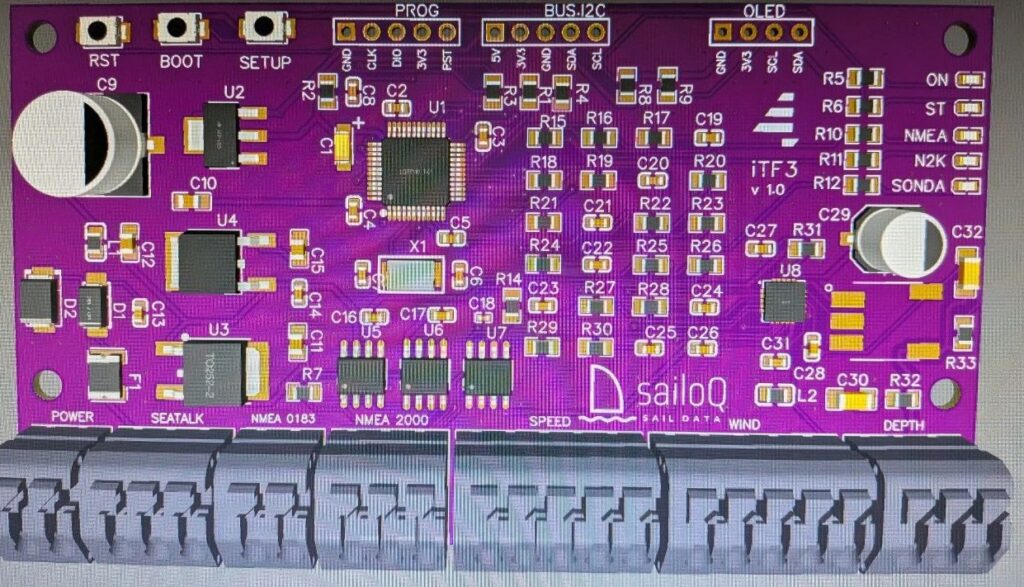
The ITF3 sends the information simultaneously over SeaTalk, NMEA 2000 and NMEA 0183. This means it can feed Raymarine instruments over SeaTalk, chartplotters and multifunction displays over NMEA 2000, and NMEA 0183 equipment such as autopilots, VHF radios or computers running OpenCPN.
It also has a connection for a small display to see the data at a glance during installation.
Designed for the sea
A single board replaces several interfaces, with one terminal block per connection and its name next to it, so installation is simple and tidy. The board will be conformal-coated to protect it from moisture and salt.
Where we are
We have already sent the first prototypes for manufacturing. When they arrive, we will test them on the bench and on the water, and we will keep you posted here.
Interested? If you'd like us to let you know when it's available, or you're not sure whether it suits your boat, write to us from the contact page. In the meantime, take a look at the other sailoQ devices.