

Posted on

Current with you or against you: how to tell with the speed log and GPS

It is one of the most common questions among sailors, and also one of the most often explained the wrong way round: which speed includes the current, the log's or the GPS's? We explain it with examples so it never trips you up again, and show how to use the difference to tell whether the current is with you or against you.

What each one measures

  • The paddlewheel speed log measures speed through the water (STW, speed through water). It is how fast the boat moves on its own, under sail or engine, through the water.
  • GPS measures speed over the ground (SOG, speed over ground). It is how fast you are really moving relative to dry land.

The key is that the current moves the water and the boat together. The log's paddlewheel travels with the water, so it does not notice it. GPS, on the other hand, measures relative to the seabed, so it does include it.

The rule to remember: GPS = log + current.

Log (speed through water)6 kn Current with you+ 2 kn GPS (speed over ground)= 8 kn
With 2 knots of favourable current, the log reads 6 and the GPS 8.

How to tell whether the current is with you or against you

Just compare the two readings:

What you seeWhat it means
GPS reads more than the logCurrent with you
GPS reads less than the logCurrent against you
They read the sameNo current (or a beam current)

Two examples: with the log at 6 knots and the GPS at 8, you have 2 knots of current with you. With the log at 8 and the GPS at 6, it is against you.

The typical mistake: thinking the log includes the current

It is easy to get confused, because it seems that “the water” is what carries the current. Think of the moving walkways at airports: if you walk on the walkway at 4 km/h and the walkway moves at 3 km/h, your legs only feel your 4 km/h (that is the log), but relative to the airport floor you move at 7 km/h (that is the GPS). The current is the walkway.

And if the current comes from the side?

In fact, speed and current add up as vectors. If the current hits you from the side, it is not fully added or subtracted: it barely changes your speed, but it pushes you off course. That is why, as well as speed, it is worth comparing your heading with the course over ground (COG) given by the GPS.

What about the wind?

Wind instruments use boat speed to calculate true wind. With the log you get true wind relative to the water; with GPS speed, wind relative to the ground. In areas with little current, such as most of the Mediterranean, the difference is small and the data is still very useful, for example to decide when to reef on a downwind leg.

And with sailoQ?

sailoQ sends the GPS speed to your display as if it were the speed log. That means you will always see speed over ground and you will not be able to work out the current by comparing the two readings: that is the trade-off, and we prefer to say so clearly. In return you forget about the paddlewheel, the through-hull and the maintenance, and you always have the speed that really gets you to your destination, with the log and wind data still working.

If you want to go deeper, we explain it in GPS speed log or paddlewheel log: what each one measures and in Why does the speed log fail?
Posted on

My Raymarine ST60 shows no speed: causes and fixes

You head out sailing, look at the display and the speed reads 0.0 knots. Or it jumps around for no reason, or gets stuck on one value. It's one of the most common faults on Raymarine ST60 displays (and on the ST40), and it can almost always be fixed. Here's how to find the cause step by step.

First: is it only the speed that fails?

A Tridata display shows speed, depth and temperature. If the depth works normally and only the speed fails, the display is most likely fine and the problem may be on the speed log side: the paddlewheel, the transducer or its cable. If several readings fail at once, check the power supply and the instruments' SeaTalk connections first.

Bear in mind that in many installations the water temperature is measured by the speed log transducer itself. If speed and temperature fail at the same time, suspect the transducer or its cable.

Symptom and most likely cause

What you seeMost likely cause
Always reads 0Paddlewheel jammed by fouling, cut cable or faulty transducer
Reads, but drops to 0 now and thenDirty paddlewheel that slows down, or corroded connector
Jumps around or shows impossible valuesPoor connection or interference on the cable
Always reads too high or too lowDisplay calibration set incorrectly

1. Dirty or jammed paddlewheel (the number one cause)

The speed log paddlewheel is always in the water and within a few weeks it fills up with algae and barnacles. A little dirt is enough to slow it down or stop it turning altogether.

Transductor de corredera de rueda cubierto de caracolillo
Speed log paddlewheel jammed by fouling.

How to check: remove the transducer from the through-hull fitting (with the blanking plug at hand) and spin the paddlewheel with your finger. It should turn smoothly without catching. If someone watches the display while you spin it, they should see the speed go up. We explain the whole process in How to clean your boat's speed log.

2. Damaged paddles or shaft

If the paddlewheel is clean but has a broken paddle or the shaft has play, it will turn badly or not at all. Paddlewheels and shafts are usually sold as spare parts, so you don't always need to replace the whole transducer.

3. Cable and connector

Check the cable from the transducer to the back of the display: make sure it isn't crushed, cut or pinched where it passes through a bulkhead. Also look at the display terminals: with the damp on board it's common to find green corrosion on the contacts. Clean them and tighten them again.

4. Calibration

If the speed works but always reads too high or too low, it isn't a fault: you need to adjust the display's calibration factor. Compare it with a GPS on a day with no current and correct the value following your ST60 manual. Note: with current, the speed log and the GPS never match, and that's normal. We explain why in GPS speed log or paddlewheel log: what each one measures.

5. Faulty transducer

If the paddlewheel turns well, the cable is in good condition and the display still registers nothing when you spin it by hand, the transducer's internal sensor has most likely failed. In that case it needs replacing.


What if you forgot about the paddlewheel for good?

If you're tired of cleaning, dismantling and replacing parts, there's another option: let the speed come from the GPS. The sailoQ cube-micro generates the same pulse signal as the speed log and connects to the SPEED input of your ST60, so the display keeps working exactly as before. With nothing in the water to get dirty.

It's just three wires and you can keep the water temperature reading. It's all explained in How to install and calibrate your sailoQ on a Raymarine ST40 or ST60.

Posted on

How to clean your boat's speed log (and how often to do it)

The speed log paddlewheel is the part of the boat that gets dirty fastest: it lives in the water, in the shade of the hull, and in summer it fills up with barnacles and growth in a matter of weeks. When that happens, the speed starts reading low, jumps around or sticks at zero. Here's how to clean it without any scares.

Transductor de corredera de rueda cubierto de caracolillo
This is what the speed log paddlewheel looks like after a few weeks in the water.

What you need

  • The blanking plug for your through-hull fitting (it usually comes with the speed log and is kept nearby).
  • An old toothbrush or a soft brush.
  • Fresh water and, for hard barnacles, vinegar or a mild descaler.
  • Silicone grease for the O-rings.
  • A cloth or towel for the water that comes in while swapping the parts.

Step by step with the boat in the water

  1. Get everything ready before you start. Hold the blanking plug in your hand, next to the through-hull fitting and ready to insert.
  2. Release the lock on the transducer (depending on the model, a nut, a tab or a pin).
  3. Pull out the transducer and insert the blanking plug straight away. A jet of water will come in for a couple of seconds: that's normal, so do it calmly but without pausing.
  4. Clean the paddlewheel: remove the growth with the brush, soak the paddlewheel in vinegar if it's heavily encrusted and rinse with fresh water. Check that it spins freely and without play.
  5. Check the O-rings. If they are cracked, replace them; if they're fine, give them a thin coat of silicone grease.
  6. Refit the transducer in the correct orientation (it usually has a mark or an arrow pointing forward) and put the lock back on.

If it's your first time, it's best to have someone with you and pick a calm day. And never leave the through-hull hole open: either the transducer or the plug must be in place.

At the boatyard

With the boat out of the water it's much easier: you can clean the paddlewheel and the through-hull fitting thoroughly. To keep it clean for longer, use an antifouling paint made specifically for transducers, in a thin coat. Don't use the hull antifouling in thick coats: it can slow the paddlewheel down.

How often should you clean it?

It depends on the water and the time of year. In the Mediterranean in summer you may need to do it every few weeks; in winter it lasts longer. A popular trick: if the boat is going to stay moored for a while, leave the blanking plug in and fit the transducer only when you go sailing. That way the paddlewheel doesn't foul while the boat isn't moving.


Or stop cleaning it

If you'd rather forget about the paddlewheel, the sailoQ cube-micro takes the speed from the GPS and sends it to your instruments as if it were your usual speed log. There's nothing in the water to clean. If your speed log is already playing up, you may be interested in My Raymarine ST60 shows no speed: causes and fixes.

Posted on

GPS speed log or paddlewheel log: what each one measures

A paddlewheel log and GPS measure different speeds. Knowing the difference helps you choose and understand what you see on the display.

The paddlewheel log measures speed through the water

A traditional speed log measures how fast the water flows past the hull. This is known as speed through the water (STW). If there's a current, the paddlewheel doesn't "see" it.

GPS measures speed over ground

GPS measures how far you move relative to dry land: this is speed over ground (SOG). It includes the effect of the current, which is what really brings you closer to or further from your destination.

When do you notice the difference with a paddlewheel log?

  • With no current, both are practically the same.
  • With a favourable current, GPS reads higher than the paddlewheel; against it, it reads lower.
  • In tidal areas or strong currents the difference can be significant; in most areas it's barely noticeable.

An example: if you're sailing at 6 knots through the water with 1 knot of favourable current, the paddlewheel log will read 6 and the GPS speed log 7. With the same current against you, the GPS will read 5.

By comparing the two readings you can tell which way the current is flowing. We explain it step by step in Current with you or against you: how to tell with the speed log and GPS.

Which one suits you?

For most leisure sailors, speed over ground is the most useful: it tells you when you'll arrive. Speed through the water matters mainly when racing, to trim sails and compare performance, or in areas with very strong currents.

Advantages of a GPS speed log

sailoQ micro 1.6, una corredera GPS sin rueda
  • Always available: there's no paddlewheel to foul or jam.
  • Zero maintenance and no holes in the hull for the speed log.
  • It tells you how fast you're really progressing towards your destination, useful for working out arrival times.

sailoQ turns that GPS speed into the same signal a speed log would send, so your existing instruments display it without changing anything.

Want to forget about your speed log? sailoQ cube-micro, available in the shop.

Posted on

How to install and calibrate your sailoQ on a Raymarine ST40 or ST60

Installing a sailoQ is simple: it's just three wires. In this guide we explain how to connect it to a Raymarine ST40 or ST60 display and how to check that the speed is shown correctly.

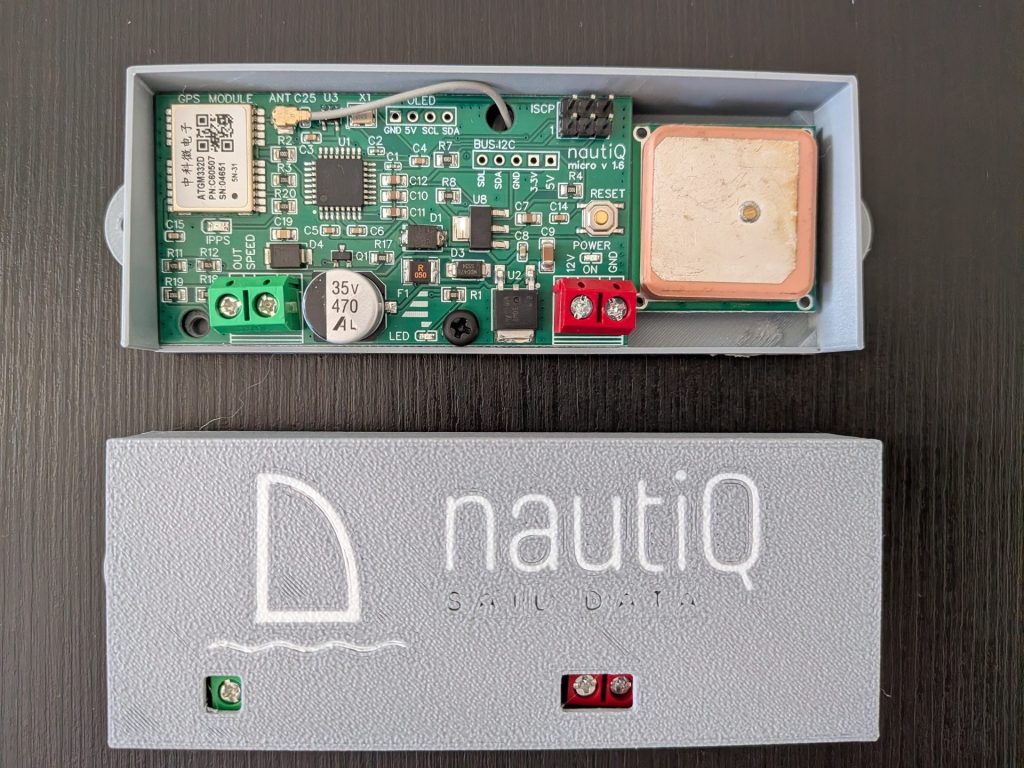
Bornas del sailoQ para conectar a una pantalla Raymarine ST60

1. Connecting to the Raymarine ST60 or ST40

  • 12 V power supply. Respect the positive and negative marked on the board. We recommend fitting a 1 A fuse and, if you like, a switch so you can turn it off.
  • Speed-log output. It goes to the display's SPEED input, on the green wire's pin.
  • Want to keep the water temperature reading? Leave the rest of your speed log's wires connected and replace only the green wire, which carries the speed, with the sailoQ's output.

2. Where to mount it

  • Indoors, protected from moisture.
  • Away from iron structures and other electrical equipment (radios, magnetic compasses…), which can interfere with the GPS.
  • It can go anywhere along the cable, although next to the display is usually the most convenient.

3. First start-up: the calibration test

Every time it powers up, the sailoQ ramps the speed up to 3.5 knots, holds it for 30 seconds and returns to zero. This test lets you check that the display reads the pulses correctly:

  • If your display shows 3.5 knots, everything is fine.
  • If it shows a different value, it's worth adjusting the display's calibration.

After the test, the GPS needs to get a position fix. It's usually almost instant, but the first time it may take a few minutes.

4. Adjusting the calibration on the Raymarine ST60

  1. Go sailing with another GPS as a reference and compare both speeds.
  2. Using your Raymarine ST60 (or ST40) manual, adjust the speed-log calibration factor until they match. If you don't have it, you'll find it on the Raymarine website.

A normal detail: the sailoQ updates the speed every second, faster than many handheld GPS units. That's why it may look a bit more "lively" than your other GPS, just as a speed log would.

Download the manual

You'll find all the details in the sailoQ manual.

Want to forget about your speed log? sailoQ cube-micro, available in the shop.

Posted on

Why does the speed log fail? Fouling, dirt and alternatives

If you have a paddlewheel log, this will sound familiar: you head out sailing and the speed reads zero, jumps around or gets stuck. It's not bad luck: when the speed log fails, it's almost always for the same reasons, and it happens to almost all of them.

Rueda cubierta de caracolillo: así falla la corredera del barco

Why the speed log fails

  • Fouling and marine growth. The paddlewheel is permanently in contact with the water and, within a few weeks, it fills up with algae, barnacles and small organisms that slow it down or jam it. This is known as biofouling.
  • Dirt. Floating debris, fibres or bags can jam it while you're under way.
  • Wear. It's a mechanical part that never stops turning: shafts and bearings wear out over time.
  • Antifouling doesn't last long. Even if you clean and paint it when the boat is hauled out, it soon gets dirty again.

Signs that your speed log is failing

  • The speed reads zero even though the boat is moving.
  • It reads lower than the GPS on a day with no current.
  • It jumps around or is slow to react when you speed up or slow down.
  • It works when you leave port and stops working after a while.

If you recognise any of these, check the paddlewheel before suspecting an electronic fault. We explain how in How to clean your boat's speed log and, if you have a Raymarine display, in My Raymarine ST60 shows no speed.

What you can do

  • Clean it often. It works, but you have to pull the paddlewheel out of the hull (with its blanking plug at hand) and do it again and again.
  • Replace it with another speed log. You're back to square one with the same problem.
  • Forget about the paddlewheel. With a GPS system like sailoQ, the speed comes from the satellites: there's nothing in the water to get dirty.

If you're interested in the difference between measuring with a paddlewheel and with GPS, we explain it in GPS speed log or paddlewheel log: what each one measures.

Want to forget about your speed log? sailoQ cube-micro, available in the shop.