


Posted on

sailoQ micro 1.6: a more robust, maintenance-free GPS speed log

The sailoQ micro 1.6 is the evolution of our GPS speed log: the same simplicity as the 1.5, but even better prepared for real life on board. We keep improving!

The micro 1.5 proved we were on the right track: simple, small and doing only what it needs to do. With the 1.6 we have kept that philosophy and thoroughly reinforced everything that makes it work better on board.
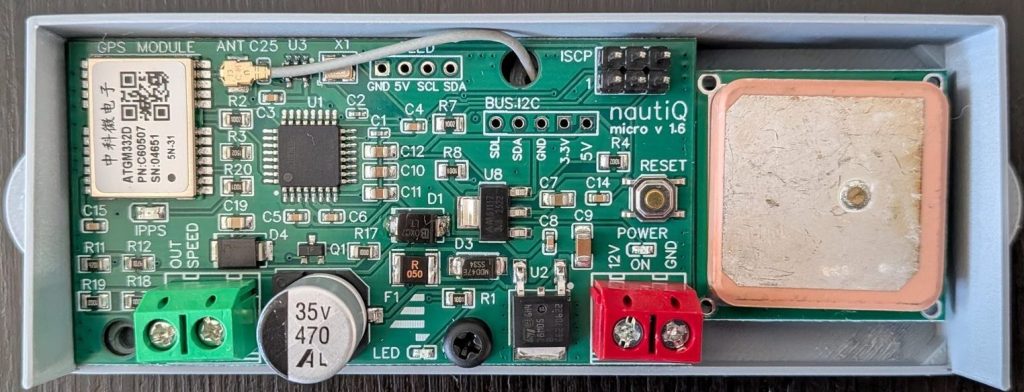
Placa sailoQ micro 1.6 con GPS integrado montada en su caja

What’s new in version 1.6:

  • Improved power supply. We have completely redesigned the 12 V input circuit. A boat’s electrical system is far from clean: spikes, voltage drops when starting the engine, noise from other equipment… The board now handles all of this much better and delivers stable power to the rest of the circuit.
  • Improved GPS antenna. Better satellite reception, faster position fix and steadier speed data, even with the board inside its enclosure and mounted on a bulkhead.
  • NMEA sentence filtering. The device discards incomplete or corrupted sentences before processing them, so only valid, useful data reaches the microprocessor. Port usage has dropped from 64 % to 16 %, four times less load.
  • Better receive buffer. Hemos ampliado y optimizado el buffer que recibe los datos del GPS, no se pierde información aunque lleguen muchos mensajes seguidos.
  • Expanded data bus. More capacity to communicate with other devices, and the board is ready for future expansions.

New software for the 1.6

The 1.6 shares its platform with the 1.5, so its software builds on the micro’s and has been adapted to take advantage of all these improvements. The big news is the diagnostics and controltool, which reports much more clearly what the device is doing at any time (GPS status, data reception, start-up…), so if in doubt it’s easy to see what’s happening and where.
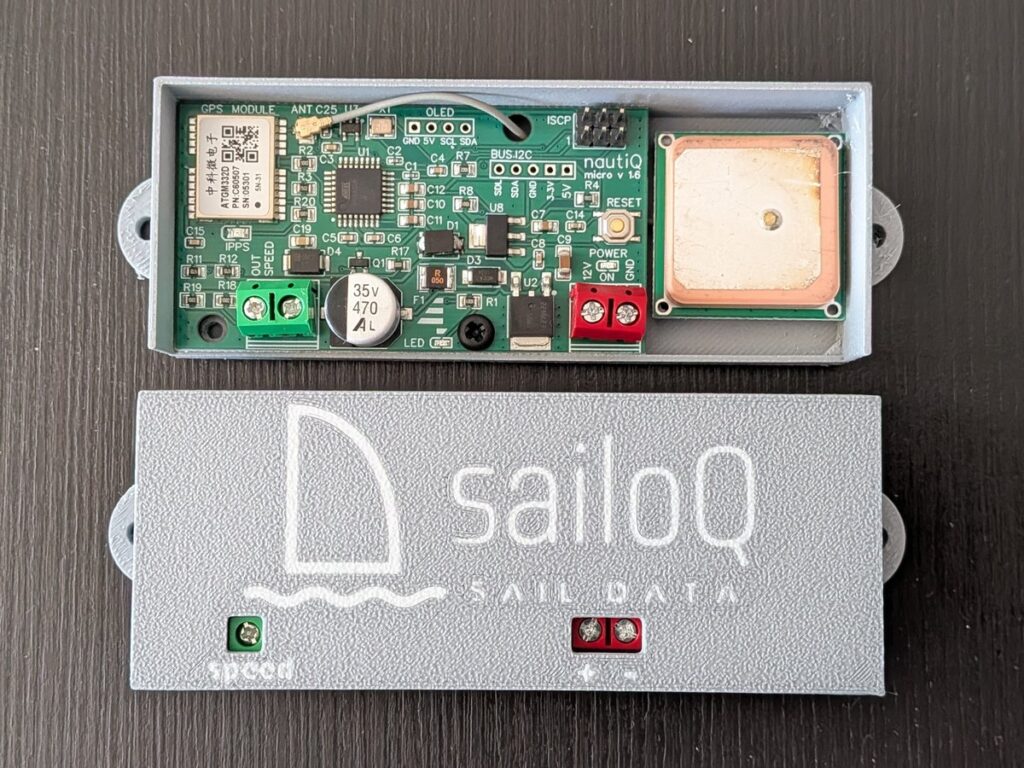
Caja sailoQ 1.6 con logo junto a la placa montada en su interior

And of course, a new custom enclosure with the sailoQ logo, for a clean and professional installation.

We hope you like it. As always, we’d love to hear any suggestions or anything you’d like to see in the device.

Installation manual (PDF): Español · English

Now available in our shop: sailoQ cube-micro

Posted on

Current with you or against you: how to tell with the speed log and GPS

It is one of the most common questions among sailors, and also one of the most often explained the wrong way round: which speed includes the current, the log's or the GPS's? We explain it with examples so it never trips you up again, and show how to use the difference to tell whether the current is with you or against you.

What each one measures

  • The paddlewheel speed log measures speed through the water (STW, speed through water). It is how fast the boat moves on its own, under sail or engine, through the water.
  • GPS measures speed over the ground (SOG, speed over ground). It is how fast you are really moving relative to dry land.

The key is that the current moves the water and the boat together. The log's paddlewheel travels with the water, so it does not notice it. GPS, on the other hand, measures relative to the seabed, so it does include it.

The rule to remember: GPS = log + current.

Log (speed through water)6 kn Current with you+ 2 kn GPS (speed over ground)= 8 kn
With 2 knots of favourable current, the log reads 6 and the GPS 8.

How to tell whether the current is with you or against you

Just compare the two readings:

What you seeWhat it means
GPS reads more than the logCurrent with you
GPS reads less than the logCurrent against you
They read the sameNo current (or a beam current)

Two examples: with the log at 6 knots and the GPS at 8, you have 2 knots of current with you. With the log at 8 and the GPS at 6, it is against you.

The typical mistake: thinking the log includes the current

It is easy to get confused, because it seems that “the water” is what carries the current. Think of the moving walkways at airports: if you walk on the walkway at 4 km/h and the walkway moves at 3 km/h, your legs only feel your 4 km/h (that is the log), but relative to the airport floor you move at 7 km/h (that is the GPS). The current is the walkway.

And if the current comes from the side?

In fact, speed and current add up as vectors. If the current hits you from the side, it is not fully added or subtracted: it barely changes your speed, but it pushes you off course. That is why, as well as speed, it is worth comparing your heading with the course over ground (COG) given by the GPS.

What about the wind?

Wind instruments use boat speed to calculate true wind. With the log you get true wind relative to the water; with GPS speed, wind relative to the ground. In areas with little current, such as most of the Mediterranean, the difference is small and the data is still very useful, for example to decide when to reef on a downwind leg.

And with sailoQ?

sailoQ sends the GPS speed to your display as if it were the speed log. That means you will always see speed over ground and you will not be able to work out the current by comparing the two readings: that is the trade-off, and we prefer to say so clearly. In return you forget about the paddlewheel, the through-hull and the maintenance, and you always have the speed that really gets you to your destination, with the log and wind data still working.

If you want to go deeper, we explain it in GPS speed log or paddlewheel log: what each one measures and in Why does the speed log fail?