


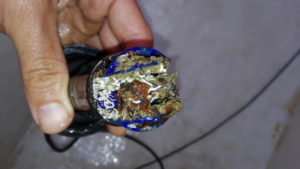
The speed log paddlewheel is the part of the boat that gets dirty fastest: it lives in the water, in the shade of the hull, and in summer it fills up with barnacles and growth in a matter of weeks. When that happens, the speed starts reading low, jumps around or sticks at zero. Here's how to clean it without any scares.
What you need
- The blanking plug for your through-hull fitting (it usually comes with the speed log and is kept nearby).
- An old toothbrush or a soft brush.
- Fresh water and, for hard barnacles, vinegar or a mild descaler.
- Silicone grease for the O-rings.
- A cloth or towel for the water that comes in while swapping the parts.
Step by step with the boat in the water
- Get everything ready before you start. Hold the blanking plug in your hand, next to the through-hull fitting and ready to insert.
- Release the lock on the transducer (depending on the model, a nut, a tab or a pin).
- Pull out the transducer and insert the blanking plug straight away. A jet of water will come in for a couple of seconds: that's normal, so do it calmly but without pausing.
- Clean the paddlewheel: remove the growth with the brush, soak the paddlewheel in vinegar if it's heavily encrusted and rinse with fresh water. Check that it spins freely and without play.
- Check the O-rings. If they are cracked, replace them; if they're fine, give them a thin coat of silicone grease.
- Refit the transducer in the correct orientation (it usually has a mark or an arrow pointing forward) and put the lock back on.
If it's your first time, it's best to have someone with you and pick a calm day. And never leave the through-hull hole open: either the transducer or the plug must be in place.
At the boatyard
With the boat out of the water it's much easier: you can clean the paddlewheel and the through-hull fitting thoroughly. To keep it clean for longer, use an antifouling paint made specifically for transducers, in a thin coat. Don't use the hull antifouling in thick coats: it can slow the paddlewheel down.
How often should you clean it?
It depends on the water and the time of year. In the Mediterranean in summer you may need to do it every few weeks; in winter it lasts longer. A popular trick: if the boat is going to stay moored for a while, leave the blanking plug in and fit the transducer only when you go sailing. That way the paddlewheel doesn't foul while the boat isn't moving.
Or stop cleaning it
If you'd rather forget about the paddlewheel, the sailoQ cube-micro takes the speed from the GPS and sends it to your instruments as if it were your usual speed log. There's nothing in the water to clean. If your speed log is already playing up, you may be interested in My Raymarine ST60 shows no speed: causes and fixes.